The weather couldn't have been nicer for this Derby Day regional. Ditto for the field, a new one for me across the road from E-Rockets near Dayton, Ohio. I "competed", or I at least showed up with most of the rockets required for the various competitions, and qualified everything that I flew. This is a G-capable field, so I brought a lot of big field birds along, but the rules state that the first flight for contestants must be the Open Spot Landing bird. I can live with that.

And what do I know about this? Not much other than if I'm going to do it, it's going to be with something that no one else will do it with. Yep, an Estes Rascal on an A8-3. Nope, I didn't come anywhere close to the spot.
I know what you're thinking. "What's with the crappy pic, Bill? Did you bring the wrong camera again?" Well, no. The camera and both lenses were with me. The memory card was at home, stuck in my computer. In moments like these I like to think of the words of the great philosophizer, Homer Simpson, who said "DOH!" I distinctly remember plugging the card in the other day and thinking "Don't forget this on Saturday." Heavy, HEAVY sigh......
So, the Rascal flight left a lot to be desired, but I climbed on the big horse right away and loaded the Enerjet 1340 clone that I'd been downloading the pictures of when I left the memory card plugged in. "DOH!" The motor of choice was an Estes 29mm E16-8 that I bought two years ago. In that time I'd stored them in a cool, dry place, so nothing could go wrong with them, right?

Right indeed. The 1340 left the pad for as satisfying a flight as I've had since I finally got the Mach 10 to work in 2002. A nice, long burn that flew slightly to the right of the pad, right into the sun. No ideas on the altitude other than to say WELL over 1000 feet.

The drama began at ejection. From the time we heard the "pop" it was obvious that it stood a good chance of intruding on one of the soccer games happening to our right. It was past the point where I'd be able to do anything about it, so I started the long walk, keeping it in sight and trying to figure the angles. In the end it was too close to call, but I lucked out when it landed just behind the last line of cars near the soccer field. It immediately drew the attention of six players of the late grade school/early middle school persuasion. At first they stood around it and gaped, but it almost instantly became uninteresting and 2/3 of the group walked off dribbling their soccer balls. The other two inched closer, and when it was obvious that it wasn't going to explode, they walked over, picked it up, and began walking it toward me. The older of the two kids was holding it by the shock cord and parachute, with a look on his face that suggested a freshly loaded diaper. They asked if I really flew it and I pointed back to our launch area. I told them they were welcome to come over and watch, but got no takers.
Next on the pad for me was a redemption flight. The original Rascal that I kicked off my day with was much like the Baby Bertha in both size and fin shape. I built the one I'd previously flown out of a starter set that I got from Ebay. It had been started and abandoned, but the decal and nose cone were still usable, so I eventually finished it. It was a simple upscale to BT-80, so I built it specifically to fly on Estes E9 engines. I thought it would be a pretty cool flight on the long burn engine, but I never got to find out.


The E9 had detonated about 100 feet off the pad. The balsa confetti cloud was impressive. No sign of the motor mount or centering rings was ever found. It was a bummer of a first flight to say the least.

I hoped today would be different. The new Rascal was a 29mm powered rocket, just like the Enerjet 1340 that I'd flown previously. That gave me every reason to believe that the Rascal flight would be an impressive one.


I wasn't disappointed. Flying on an E16-6, the Rascal left the pad on a much straighter flight path than the 1340 had taken. Ejection appeared to happen just as the forward motion stopped, and the recovery path again headed to our right. This time there wasn't the added drift that took the 1340 to the edge of the soccer game and the Rascal landed gently within three feet of the gravel road. Shades of VOA.
The next two flights were more of my competition flights. I had several hours before the competition started, so I headed to the shop and gathered up some scraps. I used a kinked section of BT-50 that had served as my nose cone paint wand for a while. I paired that with an original Estes BNC-50J that I'd picked up in a pack of three from a long ago Ebay auction. (I wanted to clone an Andromeda, hadn't discovered BMS, and Semroc was still a couple of years from resurfacing.) Also involved were a section of BT-5 for the motor tube, two centering rings from one of my Mini Max projects, an engine block, a copy paper boattail, some 1/16" balsa scrap and some Kevlar. The result looked like it came out of a garbage can.

Code name: Oscar the Grouch.
Oscar's first event was 1/2A parachute duration. The 1/2A3-2T flight was around the 150-200' level and the 18" parachute brought things back to the ground in a respectable time. I forgot to ask what the two timers came up with, but I was pretty happy with the performance. Heck, I was happy that it performed at all.

I flew Oscar again for A streamer immediately following the parachute duration flight. Streamer was an old crepe paper streamer that came out of one of my recent Ebay buys. It was two lengths taped together, 36" long, and an inch wide. Very retro. As with the previous flight, it performed fine, qualifying at a decent time and coming back in one piece. Again, good enough for me.
After the contest flights I wanted to go big again, and with the light breezes and expansive field, big meant MEGA. This would be the fifth trip to the pad for my Mega Red Max, but the first time it would fly. The previous four attempts were made two years ago at the OAMC cornfield when four Estes igniters in a row failed to light the motor.

Several years ago at NARAM I inherited a pack of Copperhead igniters from a guy whose bad luck had caused him to give up the hobby, at least temporarily. I forgot about them until they turned up recently while cleaning my build area. In the past I've never had a Copperhead fail.

Still haven't. You can't tell from this photo, but the Copperhead ignited the F50-6T on the first try. The obviously heavy rocket left the pad slowly and turned immediately to the left, indicating that the winds had shifted. The flight got to about 500', ejected while sideways, and recovered near the road.

The big thing for me was that it held together. This will be my level one rocket at some point this summer.
I have a couple of Estes Challenger II kits, one a clone with an 18mm motor mount that I built for use at B6-4 Field, the other one an original that I picked up via Ebay. This one was bent almost in half just in front of the fin can, and the fin can had been glued on with white glue. It came off with just a twist, which let me cut the body tube and insert a coupler.

It has "patina", as you can see. The body tube is yellowed and the decals chipping, but it was obviously flyable, and I had a D12-5 with its name on it.


Again, camera issues, but even with the blurring you can see that the launch was perfect. It arced back over the flightline and recovered off to the right where the bulk of recoveries happened on the day. Another wind shift. Altitude appeared to be well over 1000', which makes sense because Estes claimed 1200'.

I've been looking forward to the first flight of the US Rockets Sniper, but I had a bit of bad luck with motors this weekend. First my Hobby Lobby had two pegs full of D12-0 motors, but no D12-7s. Seems like they go together if you're a 24mm two-stage fan, but what do I know? I figured I'd just support my on-field vendor, but he was also out. I had a C11-7 and an E9-8 in my motor stash, both with explosive tendencies. The C11-7 came from the same pack as the one that destroyed my Maxi Mini Max back in February. The E9-8 was from a pack that included the motor that thoroughly killed my FSI Dart clone in 2013. My choices were iffy. I went with the C11, but not without slight trepidation.


My trepidation was well founded. The C11 detonated at about the same height that the Maxi Mini Max had been at when it blew. The Sniper is pretty stout and the only damage suffered was to the shock cord, which snapped just above the tri-fold attachment point. The body tube fell to the ground while the nose cone and chute recovered with the wind to the right. The end of the body tube was discolored by the blast exhaust, but that wiped off. The tri-fold will need to be dug out and replaced, but it should fly again on my next trip to the big field.

Circumstances kept my SLS Goblin from flying for over two years. The first circumstance was lack of a big field. The second was extreme mud at the February launch. The Goblin has a 29mm mount, so I loaded in an Estes E16-6 for the first flight. Interestingly enough, the parachute was the same one that I used on the bulk of my non-18mm flights on the day, a small neon green nylon chute that had some crispy areas from the Sniper CATO.


This was a pretty flight, high and arrow straight to 1000' plus. It actually appeared to stop at the top of the flight before the ejection charge fired, which drew a chorus of "Uh-oh"s from the flightline.
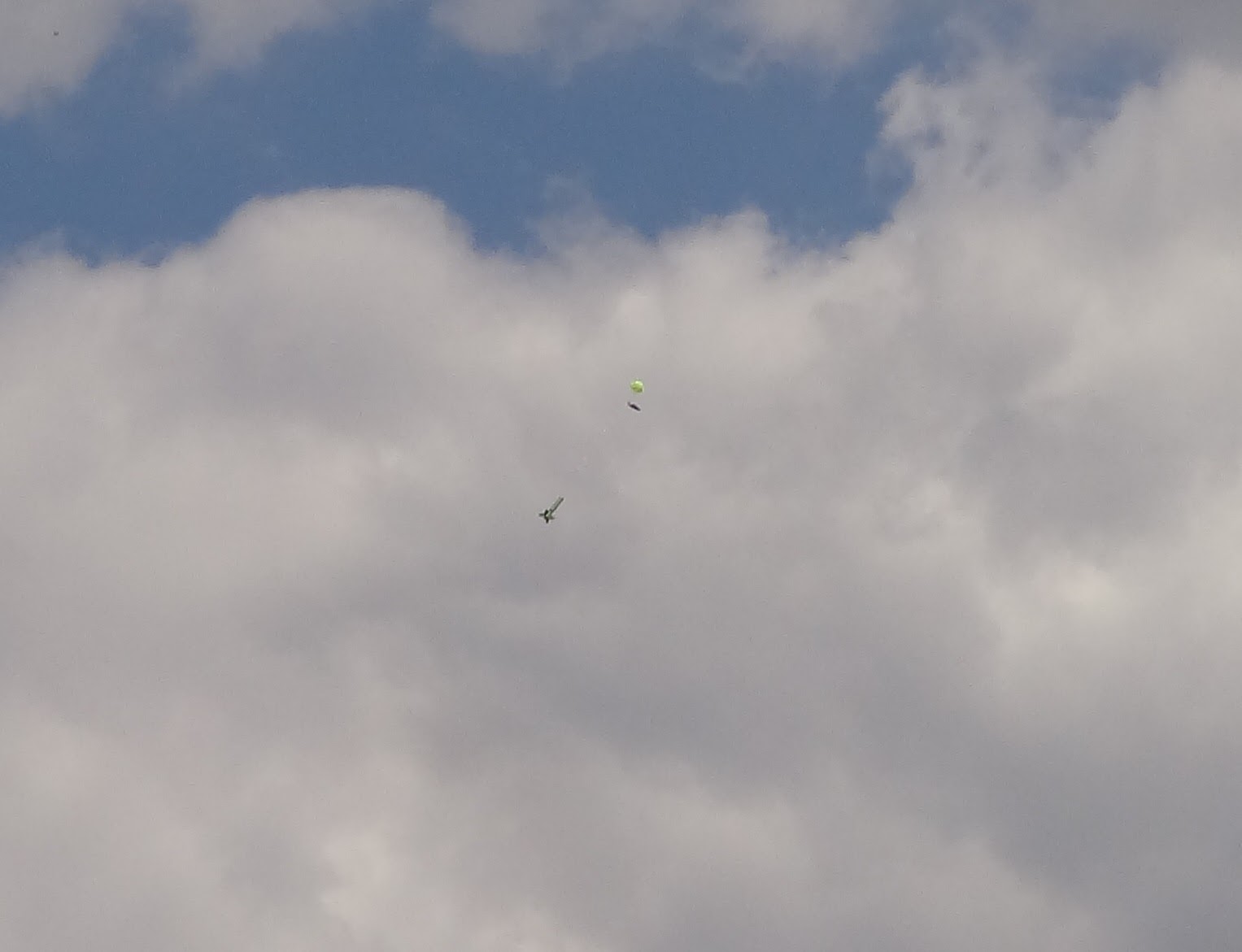

Not a problem, though. The ejection charge fired as expected and the rocket recovered 100' or so beyond the pads, and STUCK the landing. Oddly enough the fin on the other side of the fin that stuck into the ground broke. No sign of a nose cone strike or anything. Just odd.
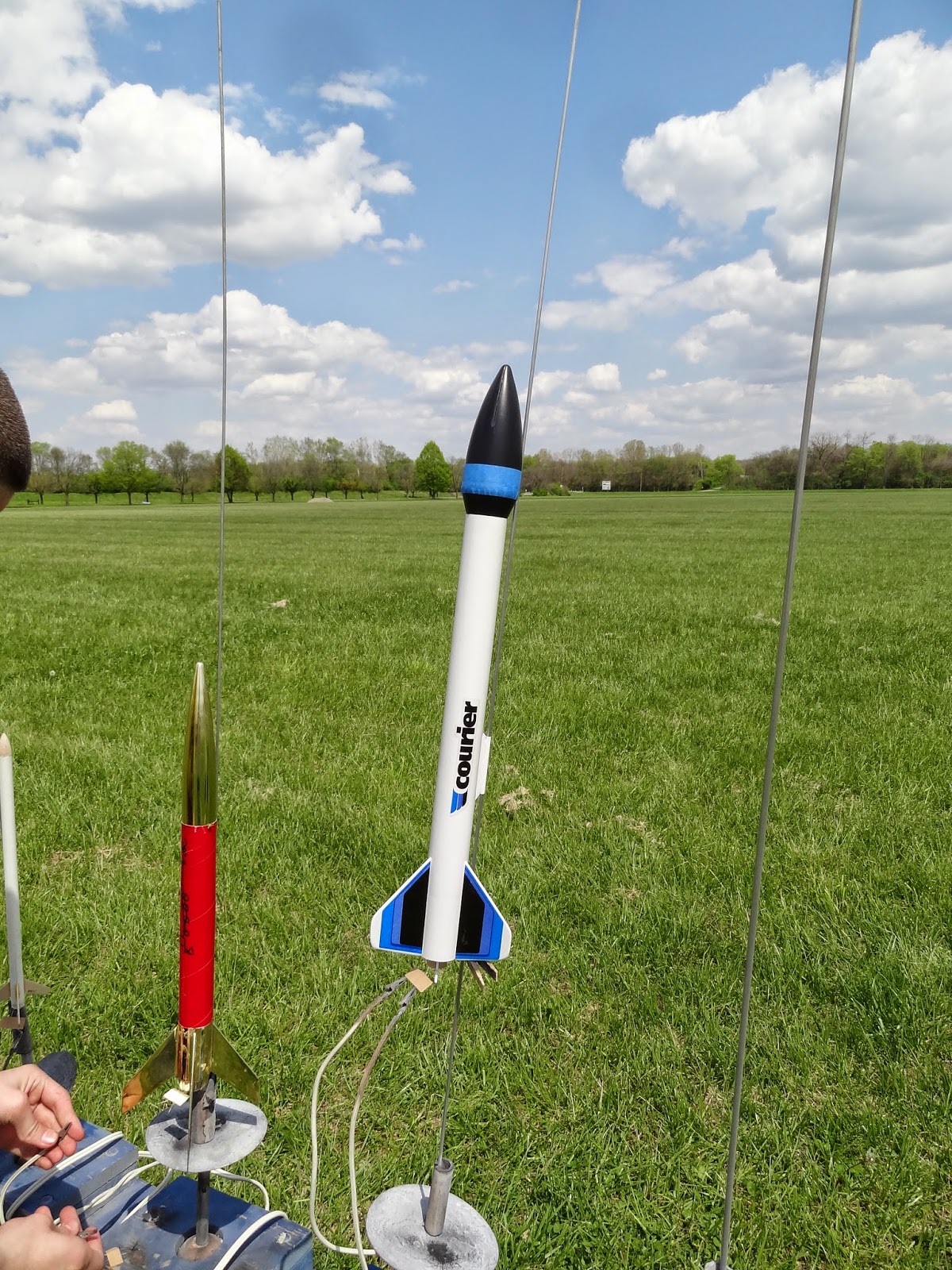
The next flight brought me back to competition flying with my Quest Courier doing the dirty work in C Eggloft. I've never done eggloft before, so this was an all new experience. I used Estes wadding to cushion the egg inside the capsule and taped it shut.

A C6-3 handled the power for the flight, and barely. It seemed to struggle with the added weight in the nose. It arced to the right off the rod, and clawed its way to 300'. At ejection the parachute failed to fill completely and it came in semi-parawad, striking the ground fairly hard. I thought my first eggloft was going to be a failure, but Egg #35 was in perfect shape at recovery. My Courier earned its status a bonafide egg lofter.

Although it wasn't planned that way, my final flight of the day would be the Astron Stinger XL on a D12-5. The parts for this rocket were among the last that I bought from Semroc before the sale, and it's always nice to think of Carl McLawhorn while flying.


Just as I'd hoped, a perfect flight. High and slightly off to the right, it landed in almost the same spot as the Courier had on the previous flight.
I was running on fumes at this point, but I was still holding out hope that I'd get to fly the TLP Dragonfly that I'd entered in the scale competition. I was told that I got good marks for craftsmanship, a definite surprise for me as I was really hoping to just show up. I was going to fly it as soon as I got back to the field, but the judge had to witness the flight. He was walking back to the range as I pulled out of my parking spot, but the lure of an iced tea was too strong at this point and I called it a day.


