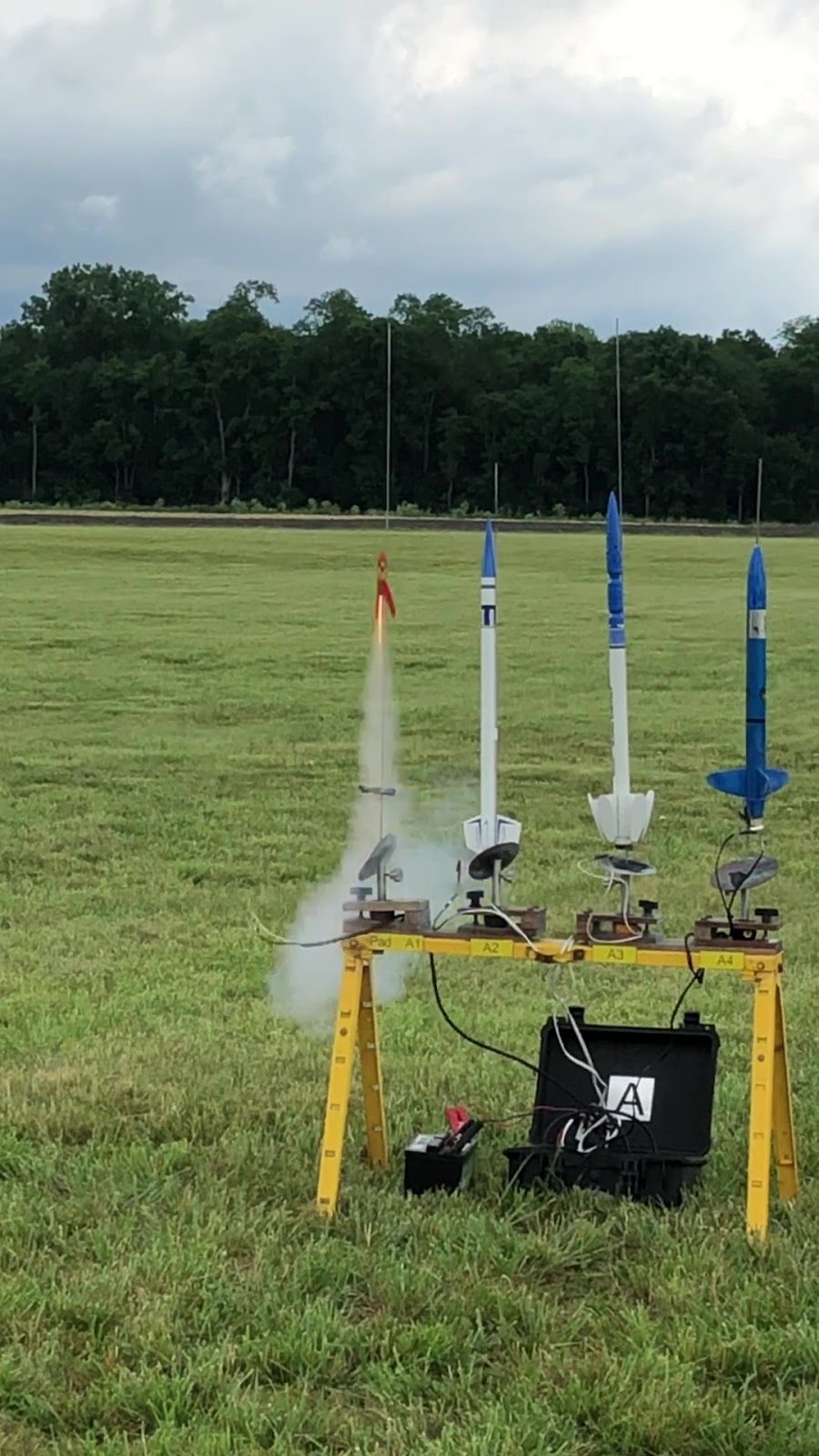
Wednesday, July 22, 2020

Return to Rip Rap Road, 7-11-20


Oh, how things can change.  Early in the week the forecast for this flying Saturday was for rain by the bucketload.  I tried not to get bummed, and as the week wore on the chances dropped daily.  By Saturday I woke up to blue skies, low humidity and a brisk breeze.  Rocket weather.
As usual, I'd over packed.  I spent part of Friday going through my list of "Saturday possibles" and prepping those that made the cut.  My daughter was in town, so I got off to a later start then expected, but by the time I arrived only three flights had happened due to issues with the launch system.  I waited around for my presence to change the flow of luck, then went to my car to grab the first victim once enough of me had rubbed off.
Or so I was told.
Very little thought went into picking the first flight of the day.  I last flew my Big Daddy on Labor Day weekend of 2001.  Nine days later our whole world changed.  That day the Big Daddy would be my very first lawn dart, almost skewering a Mazda on its straight up, straight down flight.  (The Mazda owner was bummed.  He thought having his car used as a landing pad sounded awesome.)  The Daddy survived the impact better than most rockets would have, but my enthusiasm for it waned and it got shuttled to a dark, dusty place in two basements.


Anyway, as you can see, very little work went into fixing the scars from the rather violent meeting with the early September lawn at Miami Meadows.  I almost threw it out a couple of times over the years, and at one point used it as a painting base for the nose cone of my Der Grosser Vati, likely the only reason I kept it around.  Lately I began to think it might be worth repairing, then decided to instead just clean off the dust and see how it performed.


And perform it did.  D12-5 flight, just like the bad old days.  It left the pad and arced right, unlike almost every other flight on the day that went left.  Topped out over 500', at which time the ejection charge fired and it recovered just as advertised.  I must admit that I wasn't entirely sure it would be this way.  I've been hearing a lot of chatter involving other Dads that were involved in a rocket meets earth situation just like mine, but I'm a believer.  Might be time to consider splicing in a new length of tube.

Flight 2 would be my Estes Raven.  I have a review almost finished for this rocket, but didn't have much in the way of flight pics, so it got the nod today.  It would be a C6-5 flight, or so I thought.  This was another rocket that I'd prepped for flight at both B6-4 Field and eRockets Field in the not too distant past.  I really need to be more thorough on my preflight checks.


As soon as the button was pushed on this one I realized that I had made a mistake.  Instead of leaving the pad with a bone in its nose, the Raven left with something approaching lethargy.  It seemed to be laboring on the C6-5 and the motor cut out long before it was expected to power down.  Something was amiss, and I thought back to the prep work I'd done for a scrubbed B6-4 Field launch.


I caught most of the flight on my phone without moving it, which should tell you how slow the Raven was moving.  The C6-5 flight was showing all the signs of a B6 flight.  Extreme facepalm.  At least I got the liftoff shots I needed for the review.


The flight ended perfectly with the Raven drifting in on a heavily reefed old Estes chute that I dug out of another rocket during my prep session.  The old chute performed flawlessly, but I would have issues with a vintage chute several flights in the future.

After retrieving the Raven, I noted that Randy had a table full of motors for sale under his tent, and I found and purchased the last pack of D12-7s that he had.  This would allow for flight #3 of the Estes Mega Mini Max, a saga that was on its last legs, but that I wanted to see through to the end.


If you've not followed the saga to this point, the picture should tell you a lot about the story so far.  The Mega Mini Max is a standard Estes Mini Max with just a motor block, a heavily weighted nose cone and minimal recovery system.  It's set up for 24mm flight and the only reason that I keep attempting to fly it is because I like the hot pink paint.  Flight #3 also equals body tube #3, and the nose cone and fins are all that are left of the original 2015 bird.


Leaving the pad has never been an issue with this bird.  It seems that everything that comes after the liftoff has been the problem.  Flight #1 detonated at the 150' level on a C11-7.  Flight #2 was on a D12-5 and the ejection ripped the body tube down to the engine block.  Flight #3 would be the charm.  Uh, well it might be if I hadn't lost it on the way down.  It had windcocked left off the pad, climbed out to the expected altitude, then disappeared seconds after the ejection charge fired.  It had six feet of hit pink streamer and the whole flightline lost it when I did.  I kept scanning the skies to the north, sure that I'd eventually catch sight of the big streamer, but no sighting ever happened.  I walked the field near the entrance.  Still nothing.  Looked like the Mega Mini Max experiment was over.

For my fourth flight I decided to go with another bird that hasn't seen the skies since the Miami Meadows QUARK launch back in 2001, the Estes Super Vega.  This was one of the kits that my wife bought for me when we found a hobby shop going out of business in Arlington, Texas in 1994.  I got it started soon after Christmas, but couldn't find time to finish it with two toddlers demanding the bulk of my time and attention, so it migrated to the basement.  By the time I decided to have another go at it in 2001, I decided to not leave well enough alone and built it as a 3x18mm cluster.  I borrowed a clip whip, got the motors secured, and couldn't get it down the launch rod.  For some reason I built it with a 1/8" engine mount, and after two paint jobs, it's a tight fit.  Reluctantly I pull it down and instead decide to fly the Estes Cobra variant that I picked up several years ago in an eBay auction.  I call it the Cobra Kai because I amuse me.  It needed some work to actually get flightworthy, but it's been in flying shape for a couple of years, and has even been with me to most of the late 2019 and early 2020 launches.  I really thought I got an on-pad glamour shot, but apparently my phone is A LIAR.  The pics describe the flight better than I can.


  Several years ago, I had an Estes SWAT cluster that left the pad with only two of the three motors lit.  It flew perfectly fine, nary a wiggle.  The Cobra Kai didn't so much as wiggle as flail.  Impressive feat of skywriting, but no message could be discerned.  Ejection charge fired when it was about six feet off the ground and the impact was pretty hard.  It will need lots of work to get it back in the air, but I'm already thinking of this in terms of the Mini Mega Max.  I'll get it flying eventually.

Fifth flight of the day would be the Estes Photon Probe, freshly painted and decaled and looking slicker than nocturnal raptor feces.  


Looking for something?  Like maybe a launch pic?  Don't bother looking here.  The two rockets shown in this pic left the pads together with my phone in the prone position.  DOH!  Operator error, which on a day like this is far from a surprise with all the pad difficulties.  Still, it was the third time in the last five launches that it happened to one of my rockets.  I got to see some of the flight, but only the tiniest bit.  It windcocked left, went to a respectable height on the C6-5, and ejected at apogee.  I'd used a vintage chute that I'd recently repaired and the shock of ejection must have been more than it could handle as the Photon Probe fell to earth with the shroud lines trailing and the chute nowhere to be seen.  Tough bird that it is, the Probe recovered without damage.  Next flight - nylon.  One good thing that came about as a result of a flight was the flash of hot pink I saw across the gravel parking lot.  Turns out the Mega Mini Max had found its way home after all, and all in one piece.


Next rabbit out of my hat would be another cluster, the Estes Firehawk that I hadn't flown since 2005.  The original kit was 18mm powered, but around the time I built it I was seeing any BT-60 kit as a potential cluster victim.  The amount of dust that I had to clean off of it was pretty stunning, as was how good it looked once it was clean.


Somewhere there is a video of the flight, but danged if I can figure out what happened to it.  It's not in the photo recycling bin on the phone and I can't find it on the computer.  Pity.  It did the cluster thing nicely.  Lots of smoke and flame with all three engines burning.  It windcocked left like most of the rest of the flights on the day, but at ejection the fifteen year old Kevlar snapped like sewing thread.  The nose cone and nylon parachute took off for parts unknown while the body did a freefall.  It hit hard and broke off two of the fins.  Repairable, but I'll need to pick up a balsa cone and go with the ol' Estes tri-fold shock cord mount.

For my next trick, I pulled the Jet Freak out of my hat.  (Cue Rocket Squirrel "That trick never works.")  As I make my way to the flightline, I hear "Uh-oh, he's got a glider," which is pretty much the same thing.


Actually, Rocket J. may not have been too far off.  I've built and flown a decent amount of Jet Freak gliders in the past couple of years.  They're a simple build and can often be put together in an evening with a raid of the scrap pile and a nose cone.  The one thing I've learned is that they don't react well to paint.  Dope or markers are definitely the way to go with these.  This one was painted fairly lightly, but I've not found that to make much of a difference.  I was prepared for fluttering, which is what I got.


Things looked great at lift-off.  I made my first flight of a Jet Freak with an A8-3, so I was prepared for the altitude.  No one else was.  What I wasn't prepared for was what happened at apogee.  Even 300' in the air, the ejection charge sounded like someone had sidled up to the bar and said "Make it a double."  Instead of the halting glide I'd come to expect, the thing just fluttered through the sky like a fall leaf.  Much hilarity ensued.  Many commented on my lack of trimming, but my experience had shown the Jet Freak to be extremely forgiving and usually good even by the most ham-handed of builders.  As we watched it flutter back toward the field I was thinking that it had blown the nose cone.  It landed deep behind the mid-power pads and another flyer picked it up and brought it to me.  Not only was the nose cone missing, the entire engine mount and boom were gone, leaving behind a clean stripe of bare balsa where they once resided.  The bad news is that I have to buy another nose cone and find another scrap piece of BT-20.  The good news is that all I have to do is glue it in place on the empty spot.

Next to fly would be the FSI Viking III, or a reasonable facsimile thereof.  This was a project that had come about due to a late night screw up.  It had been meant to be a minimum diameter 24mm powered clone, but the Kevlar got tangled, and instead of screwing the whole project up trying to right the error, I turned it into an 18mm small field bird.


The Viking left the pad and arced to the left, but not nearly as bad as many of the flights on the day had.  At ejection it raced back across the field, winding up in the gravel parking lot and being dragged through the old blacktop by the strong breeze, earning a few new scratches, but no other damage.


Next to last on the day would be the BT-80 upscale of the Estes Goonybird Missile Toe.  My first Goony upscale had been a modified Estes Fat Boy, and as such, built with 18mm power.  This turned out to be a little lacking in power, so I built the next one, the Missile Toe, as a 24mm D powered bird.  This was a big improvement in the power category.  Between the added power and the oddball fin setup, the flight characteristics of the Toe would likely be described as "spirited".
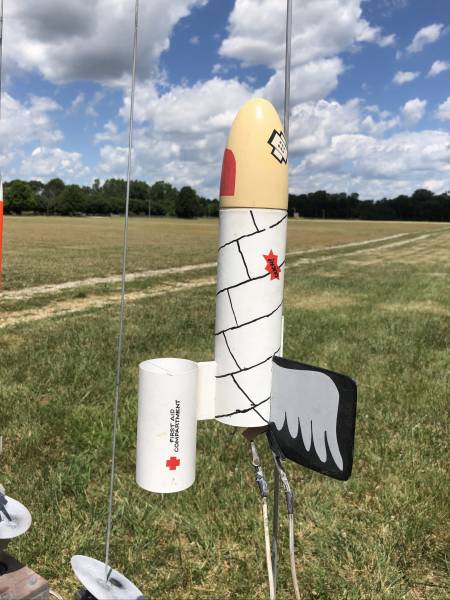

No surprises here.  Todays flight was just like the previous ones, leaving the pad in a hurry, windcocking left and jinking all the way to apogee.  At ejection the Toe raced back across the field to the gravel just like the Viking III had, but the landing was quite a bit more violent.  Apparently a fin was splintered at impact and additional damage caused by the subsequent dragging across the gravel.  It will fly again.  It just won't look quite as good.


It wasn't planned that way, but the last flight of the day would be a recently built clone of the Estes Astron Skyhook.  I'd previously built two Skyhooks before this one, and to say I've got a checkered past with them is understating it a bit.  Before today I was two for two.  Built two, lost two.  After today I'm three for three.  


The flight would be on a B6-6.  I knew this would be a high flight, but it's such a big field that I thought I stood a decent chance of getting it back.  Recovery would be handled by six feet of hot pink streamer.


The flight itself was unremarkable.  Instead of windcocking violently to the left, it was more of a gentle curve to the left.  I was able to watch it the whole way and I began counting after it began the coast phase.  I got to six and saw nothing.  Then I continued to see nothing.  I scanned the skies for the flash of hot pink from the streamer, but still saw nothing.  I walked the whole left side of the field and finally found something, but it was nothing.  Nothing was what I'd continued to find for the rest of the afternoon.  At this point I was out of things to fly, bummed about losing another Skyhook, and burnt out to the point of being glare-blind, so I called it a day.

I should mention the other two of my three non-flights.  Aside from the aforementioned Super Vega, I also made attempts with the Estes Sequoia, 


which sat on the pad through several cycles over this launch and the previous launch, and the Semroc Point.


I'll try the Sequoia sometime later.  I think it was just a bad ignitor.  The Point might be too big of a pain to actually fly.  I bought some cheap gator clips to extend the reach of the pad clips, but the wires to the cheap clips melted.  At least we know the pad was getting power that time.


Monday, June 22, 2020

Wright Stuff Rocketeers launch, June 13, 2020

After a bunch of socially isolated launches through March and April, I was more than ready to attend a club launch by the time May rolled around.  Unfortunately, circumstances demanded that we hold off until mid-June, so I was REALLY ready.

The launch was scheduled from 11am to 5pm, but weather moved through the area right about the time the launch was scheduled to start, so it was moved back an hour.  I ran through intermittent showers on the one hour drive to the field, but nothing serious, and it was showering lightly for 30 minutes or so after I arrived.  We got the field set up and were flying by 1:30.

First flight on the day for me would be the Red River Rocketry USS Prometheus.  I'd bought and built the kit several years earlier, but made a mistake in construction that made it look odd to me.  As a result it never made it out of primer.  A few weeks back I decided to see if I could correct my mistake and the results were to my liking.  From there the project finished quickly, and I actually had it prepped for B6-4 Field duty with an A8-3.  That launch never happened, so I was looking forward to seeing it lead off on Saturday.


Today conditions were all but perfect, allowing me to fly it on a C6-5.  There was a breeze, but it was intermittent and didn't appear to be there to do much more than fluff the parachutes and blow the baby powder around.  


The flight was perfect, dead straight off the pad and a lot higher than the A8-3s I'd become accustomed to at B6-4 Field.  It was good to not see the whole flight up close and personal for a change.  Ejection came just after the Prometheus tipped over and nothing happened.  I cinched up immediately as the rocket began a freefall from around 800'.  Something was fluttering along beside it, which we took as a parawad situation, but 30 feet from a hard hit the chute finally unfurled and disaster was averted.  The rocket landed just beyond the mid-power pads and was recovered without damage.

My second flight of the day was the legendary Rokitflite Odyssey, one of the coolest sci-fi kits ever produced.  This one hadn't flown since 2006 when it was destroyed by an LFK.  My fault.  I brought leftover Halloween candy.


The Odyssey is a C6-3 bird.  I had one.  Problem is I brought two C6-3 birds.  The Odyssey had been prepped at home, so it got the last C6-3.  Apparently they're in short supply in some Hobby Lobby stores.  The flight was straight to around the 600' level.  


The Odyssey appeared to be in trouble at ejection and was initially heading straight down after a less than enthusiastic ejection charge.  It eventually flipped around and began falling sideways.  Twenty feet from disaster the chute filled and slowed the rocket some before a hard hit.  Damage appeared to have been averted at the field, but when unpacking at home I discovered a fin had loosened fairly badly.  It's always something.


Third flight on the day would be the only casualty of the day, my Estes Mega Mini Max.  Several years ago I couldn't seem to make a Hobby Lobby run without pickup up an Estes Mini Max kit.  I built them in assorted colors, did one with 18mm power, and finally decided to do one as a minimum diameter, 24mm powered bird.  First flight came five years ago in the WSR cornfield on a C11-7.  A CATO at the 150' mark completely disintegrated the body tube above the fin can, and hot pink cardboard rained down onto the mud of the cornfield.  A few weeks ago I decided to rebuild it with the original fins and nose cone and try again.


I overdid it on the nose weight, so the result feels like a piece of artillery when loaded.  This flight would be on a D12-5 because I haven't seen a D12-7 for a while.  (And I don't trust the C11-7 anymore.)  The LCO commented that I should have traded someone, which would have been a good idea if there had been someone in my basement with a D12-7 when I was prepping.  Whatever.  I was committed.


This flight was a lot like the one five years ago, albeit without the explosion.  Dead straight off the pad to a very impressive height, well over 1000'.  Ejection didn't appear to come early but as the rocket descended, the streamer didn't appear to have deployed.  As it got closer I could make out a bit of the streamer fluttering.  Closer still and I could see the body tube fluttering.  Past experience has taught me that this is rarely good.


And it wasn't.  Could have been worse as it was heading right for the flightline and that nose cone would definitely leave a mark.  One of my fellow flyers made the pro-bowl catch behind the cars.  For my troubles I was awarded with my second worst zipper ever.  Note to self, Mega Mini Max v3 will need a D12-7.  Hopefully not five years from now.

Fourth flight would be a recently modified Estes GeoSat LV.  I picked this up built and flown from eBay and flew it once on the C6-3 recommended by Estes.  It's a big rocket and the C flight was underwhelming at best.  After another similar flight I began thinking about switching the 18mm mount out for a 24mm mount.  It took me five years to think about it, then one night several weeks back I passed it in the hallway, pulled out my multi tool and yanked the old mount out.


Still wearing some of the dirt from the last cornfield flight, the GeoSat LV would fly on a D12-5 with all new internals, as I ditched the rotted tri-fold mounted shock cord for a new one with heavy duty Kevlar and stout sewing elastic.  The expected change in performance was everything I'd expected it would be.


Instead of leaving the pad clawing for altitude like it had on the C6-3, the Geo Sat LV left the pad looking as spry as a Sky Hook on a C6-7.  There was slight windcocking to the left, but the flight was fairly straight overall.  Hard to say what the ultimate altitude of the flight was, but it flirted with 1000' and looked good doing it.


What I learned from this flight was that I lucked out and picked the five second delay over the three second delay.  As it was the ejection charge fired just as it tipped over.  Three seconds would have been a tad too early.  

From this point on I'm having to replace everything from flights 5-9 because they didn't save when I pressed the save button.  That said, I'm still getting bang for my buck from Blogger. 

Fifth flight on the day would be another minimum diameter D flight, a Custom Venture that I'd had built for ten years plus.  The original had flown twice in 2004 with the first flight being a lesson in nose weight for me.  The second flight landed by the park access road at VOA, but was "rescued" before I got to the spot.


This one suffered from paint problems, which is why it hung around unflown for 15 years.  I recently decided to refinish it just to get it in the air.  This flight would be on a D12 with a 3" wide by 4' long streamer.  It would fly high, but I figured I should see something at ejection with that setup.


Yup, flew high, windcocking fairly sharply to the left of the pad.  It was still moving up at ejection, but not at a velocity that would cause damage.  I was expecting a long majestic streamer, but nothing was streaming.  As it got closer it was obvious that things had tangled on the shock cord.  The descent was fairly slow, sideways, with the weighted nose cone leading the way as it drifted back across the field.


The whole mess came to rest back behind the mid-power pads to the right.  No damage from early ejection or the hard hit on the ground.  It should fly again, but I hope to find some D12-7 motors before then.

Flight #6 was an Estes Astron Streak that I picked up as part of a late night "Buy It Now" purchase on eBay.  It reeks of vintage, with a hippy-dip paint job and decals from one of the generic Estes decals sheets.  It came along with another oldie, an Astron Sprite that I'd already flown, and nearly lost, on an A8-3.  I had the Streak loaded to fly that day, but chickened out when I almost didn't recover the Sprite.  


Today I had a big crowd and a large field, so I loaded it with a 1/2A6-2 and called a heads up flight.  That turned out to be a good call as I lost it as soon as it left the pad.  The 1/2A ejection charge wasn't quite as shotgun like on this flight, but as I scanned the skies after the launch I was sure it was lost.  Luckily the crowd had better eyes than I did, and Loopy saw it land behind just beyond the mid-power pads.


Landed without damage.  Might give it a try on an A8-3 some calm day, but I also might retire it now that I can be sure it has flown.  It's a rocket.  It's what they're supposed to do.

Flight seven was the Semroc Sigma II, one of two Semroc kits from the original lineup that Carl never got around to reproducing.  (A Black Brant III was the other.)  At this point, no actual documentation exists as to the fin pattern for this kit, so I used the catalog representation from the 1970 Astronautic Modeler.  http://www.ninfinger.org/rockets/catalogs/semroc570/570semroc36.html  Not perfect, but close enough for me.


I went conservative for the first flight with a B6-0/A8-5 combo.  Things were fairly calm when I loaded it onto the rod, so I figured that I'd be able to see the whole flight.  That idea lasted until the button was pushed when a big gust blew across the field.  


The Sigma II windcocked to the left off the pad, but things didn't become critical until it staged.  The booster raced back across the flightline and the sustainer disappeared on a horizontal flightpath.  I got distracted by the booster and saw no more of the flight, but I knew approximately where an A8 flight might take the sustainer.  I'd loaded it with a bright pink streamer just to make spotting it in the air and on the ground a bit easier.  With this in mind I began walking the field toward the fence, scanning the freshly mowed grass for a flash of pink.  I got all the way to the fence, then turned and walked back from another spot even with the launch pad.  Not a flash of pink.  I began wondering if I still had the fin patterns to recreate the sustainer.

My eighth flight of the afternoon would be a clone of the Estes Arrow that I built before NARAM 55 using an Estes Screaming Mimi as a donor kit.  Over the years I bought quite a few Mimis.  The kit was like a Designer's Special for me and I built many of the kits that used the PNC-60AH nose cone, and many a Hobby Lobby trip ended with me buying another Mimi with my 40% off coupon.


I was surprised to find that some of the people I was flying with at NARAM thought the Arrow was a scratch build.  Mark VanLuvender commented at this launch that he'd never seen another Arrow in the wild other than the one that he built some years before.  As I was carrying it to the pad I was struck at how sturdy it was.  It has six fins and I did mine in basswood, so it feels quite a bit heavier than a normal bird.  Flying on a C6-5, the Arrow was noticeably slow off the pad and left angling into the breeze to the left, standard on the day.  Things topped out around the 700' mark and ejection occurred as forward motion stopped.  


The winds started picking up during the flight and at ejection the rocket began racing back across the field toward the maintenance garage.  The closer it got to the garage, the less the garage appeared to be in play.  The storage containers behind the garage, however, looked like a definite possibility as a landing area.  The Arrow hit the top of one of the containers, but bounced off and landed on the ground behind it.  Fine with me.  At this stage in life any climbing I can avoid is a plus.

Ninth flight was an Estes Monarch in full livery.  This is my second Monarch.  The first flew in primer, then in full paint, with the decal application planned for after the flight.  Never happened.  At this point it has been in a tree at B6-4 Field for six years.  I waited for this one to be completely finished before I was tempted to fly it.


I took it to the LCO table to check in and found the sustainer for the Sigma II.  Someone had retrieved it and dropped it off.  Never found out who to thank.  As for the Monarch, it would fly on a C6-5.


The winds had faded to their normal breezy self.  The Monarch windcocked lightly to the left off the pad and topped out around 750', popping the chute just as it turned over.  Things were obviously a little windier above the pads as the Monarch rapidly began drifting back across the flightline.  There is a maintenance building behind the flightline and to the right, and I began to worry that I might need to get on top of the building to retrieve the Monarch.  Luckily I'm not one who minds using his car as a ladder in emergency situations, but that point became moot when the Monarch fell short of the buildings.

Next up, flight #10, would be a C6-5 flight for the Space Station Aquarius, an Estes kit sold by PDR back in the mid 2000's.  PDR stood for Pimp Daddy Rocketry, but they soon changed to PD Rocketry in order to keep from offending.  The name didn't bother me at all, the business practices did.  For a couple of years PDR was as popular as the refurbished Semroc.  The kit lineup was impressive and focused on 1970's-80's Estes kits and a few cool scale kits.  They did a brisk business and things looked good on the surface.  I picked up six kits and had several others on my want list when orders started taking forever to fill, then stopped altogether.  Promises were made for refunds.  Excuses were made involving a family emergency and transfer of the business within the family.  Then silence.  I'm not sure how many lost money due to this exit strategy.  I wasn't one of them, being between orders when things started going south, but I knew a number of those who'd been left high and dry.  


The Space Station Aquarius is a great looking kit, even with my less than exacting build skills.  The only mark against it was the decals seemed to lack adhesive, as evidenced by the solar panel decal that floated away on one of the initial flights at VOA.  That could have been an issue with my application, so it's a wash.  I always meant to print off a new decal, but I've never managed to fin the time for the project, despite an excellent scan of the decal at YORP.


The flight mimicked most of the flights on this day, windcocking slightly to the left as it left the pad.  Ejection occurred around 700', just as the rocket tipped over.  It began a slow drift back toward the pad before recovering near the outfield fence of the baseball field.

Last flight for this day would be another PD Rocketry product, the SS Cassiopeia.  This was the first rocket I bought from PDR and it flew once back in 2006.  It turned out nice, but I flew it without decals the first time, usually a mistake for me as we've learned.  After a C6-5 flight it landed on the asphalt access road at VOA.  Despite the fact that the road was narrow, I had a lot of rockets land on it over the years.  The Cassiopeia fared the worst out of all of them.  The landing tore the ring fin off the back of the rocket and shattered most of the mounting points.  It was so thoroughly damaged that it sat in my repair pile for 14 years.  The only reason I decided to see if I could fix it was because I was socially isolated and running out of projects.  As you can tell, the nose cone was scavenged for another project, but I have several of these laying around from various sources through the years.


Clouds had really rolled in and thickened by the time I got the Cassiopeia to the pad, and we were drawing closer to the 5:00 shutdown time.  I thought I still had time for this flight and the mini-engine Sequoia, so I was glad that I'd prepped the previous night.  The C6-5 flight boosted straight off the pad and only windcocked slightly as it rose.  Ejection occurred almost perfectly at apogee, and it began the now familiar cross field trip to the open area to the right of our pads.


It was one of the few that I followed all the way down with my phone.  I liked the backdrop of clouds on recovery and actually managed to get a few frames with the rocket actually recovering with my point and pray method.  The landing was fairly soft and the previously damaged ring fin held up to the contact.  


At touchdown I still found myself with fifteen minutes before the end of festivities, so I grabbed the pre-prepped Estes Sequoia and filled out a flight card.  We tried, but the Sequoia sat through four attempts before I decided to pull it down and likely start with it the next launch.  We'd been having occasional pad issues all day which caused the need to recycle the wireless system to start the signal again, but I think that the problem may have been with my igniter.  I'll change that before the next launch which is scheduled for Saturday, June 27.  Be there or be somewhere else, but be flying.