Tuesday, August 18, 2020

Maxed out launch, Dayton, Ohio - August 8, 2020 - Part 1

Yeah, still 2020. Hard to believe I stayed up until 3am to welcome this year in. That said, between club launches and social isolation launches, I've had a banner year from a rocketry standpoint. 136 flights with four months left to fly in the year.  My personal best is 160 in 2013.  Last month I thought I had an outside chance to top 200.  Not sure I've got that in me anymore.  I'm also nine flights from 1700.  Clearly I've still got a lot to fly for from a personal standpoint.
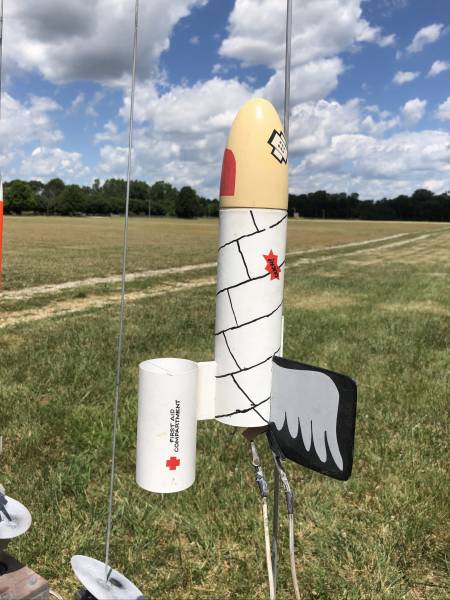
Over the years I've collected a fairish size collection of Der Red Max rockets.  It started innocently enough when I came across a PNC-60AH nose cone in 2002 and immediately began the process of putting the iconic rocket body underneath it.  I had only recently started experimenting with making my own decals, and had actually had some decent success.  My problem was that a big part of the Red Max decor is the white, and only an Alps printer could replicate that.  To sidestep the issue, I bought a pack of white shelf paper, printed the decal on typing paper, and cut the white background out where it would show best, behind the skulls and crosses.  From ten feet it looks great, and only the sharpest eye would catch the missing white areas.  Considering the Goblin vs. Red Max thing going on over at Facebox, I think this 2002 photo shows that I was a seer, well ahead of my time.


Yeah, no.  I just saw them as Estes classics.  At least I got that much right.

Over the years my Max collection grew, usually by accident.  I did some beta builds for Retro Rocketry, BT-20 sized Mini Red and Blue Maxes.  Then came a Goony Max from Phred at Excelsior, a Baby Bertha based Red Max with custom decals.  (Two, actually.  I treed one on a review flight, so he sent me a new decal set.)  Estes then reissued the Red Max, and I built a regular version and a Der Big Red Max version.  Still, I had no clue of the mania taking hold.  I built two more Excelsior birds, Der Fat Max, which used an Estes Fat Boy as a donor, and Der Grosser Vati, which really isn't gross at all and uses an Estes Big Daddy as a starting point.  The real trigger was the Estes Mini Max, a BT-50 stroke of genius readily available at Hobby Lobby.  Armed with my 40% off coupon and making several trips a week, I soon had myself in the habit of picking up a Mini Max when I felt like building something.  Soon my Max collection had grown noticeably, so much so that I set them up for a family portrait.


At this point I couldn't really deny it.  My fever had Maxed, and it would get worse.

By the time of our August 8, 2020 WSR launch at eRockets Field, I was up to 21 Maxes.  I thought I was bringing them all with me, but two missed the bus, one that I left on my desk while trying to gin up a decal for it, the other because I felt like it was a stretch.  (It had the paint, but nothing in the way of decals.)  I'd prepped everything the night before, so all that was left to do was plug in an igniter and take them to the pad.  Motors ran the gamut from 1/2A to G, missing F.  (Had I thought about it, I'd have packed a 1/4A in the Miniscule Max and bought an F from Merlin Missiles for the Der Grosser Vati.)  First, another family pic, (because not all would be able to pose for a post-launch photo.


The day was almost perfect for flying.  Mid-80's, full sun, little to no humidity and an occasional breeze..  I had planned to go from small to large on the day, but found a crack in the fillet of the Miniscule Max, a BT-5 home built with Excelsior decals.  Instead the first flight would be the Retro Rocketry Mini Blue Max.  Fitting in a way.  As I said earlier, Mini Blue was one of two rockets that I did a beta build on for Retro Rocketry.  The first two rockets were to be the Mini Maxes, followed by a Mini Blue Bird Zero and Mini Wolverine.  Something happened, likely Estes stepped in and stopped them.  Not sure if any kits were ever offered for sale. 


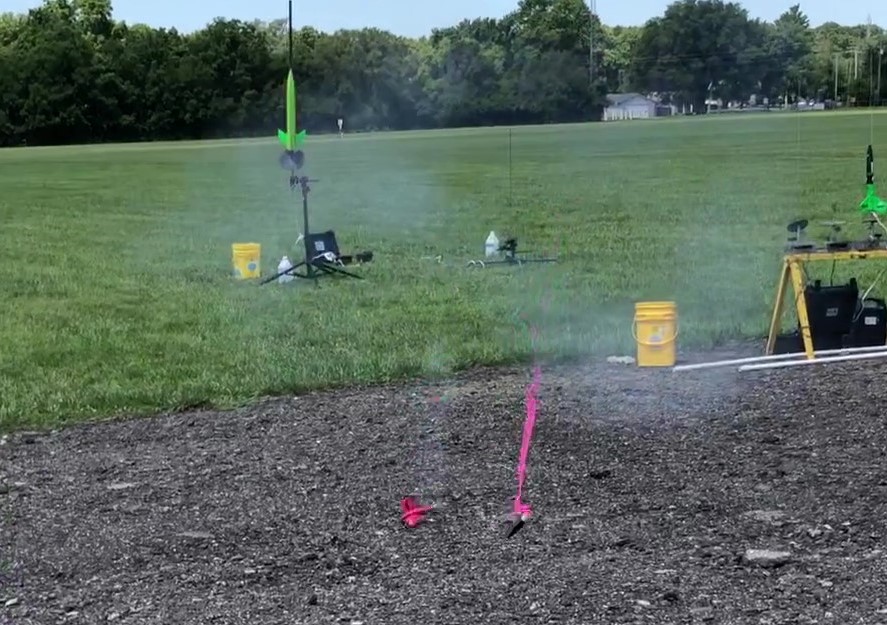
Sadly, this was all I got of the flight.  Pad issues, then when I put down my phone, the LCO said "Let's try one more time."  It worked.  1/2A3-4T flight because I couldn't find A3-4T motors anywhere.  Straight off the pad.  Decent altitude.  Streamer recovery just to the right of the pads.

The Retro Rocketry Mini Red Max was next to the pad, also on a 1/2A3-4T.  


Not surprisingly, the Mini Red Max had an almost identical flight to the Mini Blue Max.  Mini Red left the pad leaning more to the right, but straightened out nicely to about the 300' mark.  It landed within a few feet of the spot where Mini Blue landed.  I picked it up and began walking back to the car, then saw that a fin was missing.  I walked back and found it at the landing spot.  It had been under the rocket body, so I hadn't noticed it.  Easy repair, and it will fly again.

The next four flights would be Estes Mini Maxes, all different colors and all flying on A10-3T motors from the same pack, recently purchased at a local Hobby Lobby.  The first in line would be the Mini Gold Max.


Unlike the two previous flights, Mini Gold left the pad angling to the left.  When I say angling, I mean about three degrees.  The flight was largely straight to the 400' mark and ejection occurred as it was tipping over.  The streamer, having been balled up since I put the dog barf in earlier in the week, streamed lazily at best, but the recovery was still fairly gentle, landing in the grass, but missing the asphalt by only a few feet.

Flight #4 would be the big surprise on the day.  I had been going over my flight logs in preparation for Max Saturday and noticed that I didn't have a red Mini Max listed.  I knew I had one because I specifically bought it to replace the one I treed on the first flight at B6-4 Field.  Sure enough, I found the red Mini Max in with the rest of the Maxes.  When I checked it for flight evidence I found that the nose cone had never even been attached.  Somehow I'd never managed to fly it over the years.


Looks great, doesn't it?  The A10-3T motor was from the same pack as the others.  (Which would cause a bit of tightening for the next two flights.)   It was as normal as pumpkin pie.  (Vague movie reference.)  Pics come hot and heavy from this point.


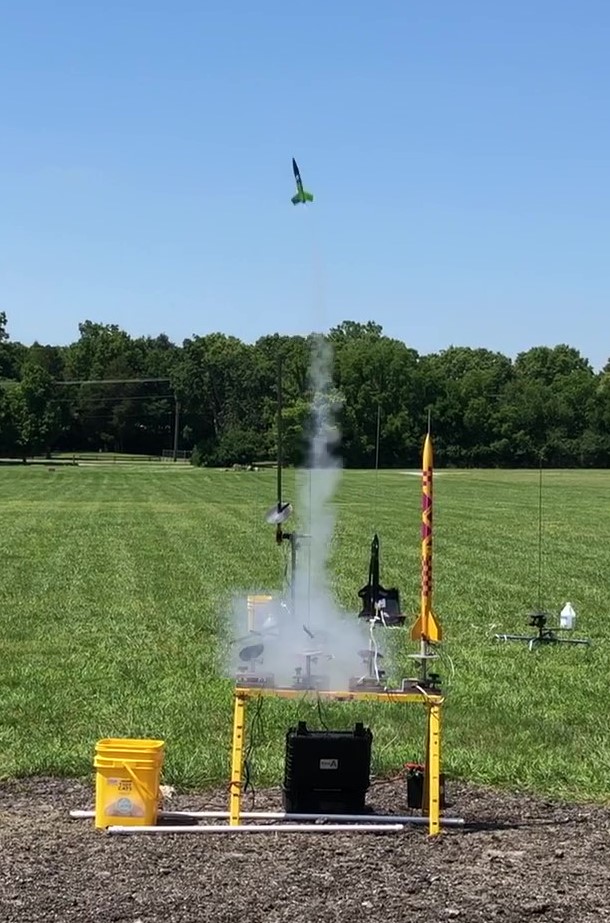
Nothing about this ever looked like a normal flight.  There was that telltale firecracker bang the instant the button was pushed.  Luckily I kept my phone pointed in the right direction the whole time.  The Mini Max lifted off the rod, but by the time it moved it was already chasing the nose cone and streamer.  I was dimly aware of the flames exiting the top of the rocket, but you couldn't miss the smoke.  Altitude was down on this flight to only 15' or so.  After what seemed like an eternity the whole smoking mess crashed into the asphalt in front of the pad.  Quite a show.  I've been a CATO victim on a fairly regular basis over the years, mostly E9s, but several C11s, a B6-4 and a previous A10-3T.  Most of the time all I need to do it take the rocket home, clean off some soot, and replace the shock cord.  That wouldn't suffice this time.  The Mini Max was incinerated internally.  There are spots on the body tube that are being held together by the paint and decal, and crumble to the touch.  The wrap decal at the top of the body tube is discolored, and a very definite line works its way down toward the launch lug.  Under that line is ash, and not much else.  The Kevlar had been tied in behind the forward centering ring.  It burned through somewhere in front of that.  But I got the whole flight on camera.  Major cool points.

Back at the car the Lemon and Lime Mini Max twins cowered, neither wanting to be next in the game of A10 Roulette.  Luck of the draw wound up pointing at the Mini Lemon Max.


Nary a hiccup for this one.  It left the pad on the same flight path as Mini Gold two "flights" earlier, lightly arcing to the left and slightly behind the pad, the riding the light breeze back toward the asphalt.  Like Mini Gold it came up just short.  Other than the Mini Max, which really just dropped there, I only had one flight that found the asphalt on this day.

Last of the A10-3T pack would go in the Mini Lime Max.  One of the giveaway kits from Carl McLawhorn of Semroc had been a reissue of the RDC Moon-Glo, a tiny spaceship that just begged for a metallic green paint job.  Green was the color that my parents chose for a cars, so not a lot of my rockets wound up green, but I bought a can specially for the Moon Glo.  That left me with a lot of leftover green paint, so one of my Mini Max projects was bound to turn up green.  The decals showed up nicely against it, which was a bonus.


As with the rest of the Maxes on the day, the Mini Lime flight was relatively straight.  Flight topped out around 400' and ejection occurred just as it tipped over.  Breezes had kicked up slightly by this point, so recovery was deeper in the field, but still a textbook B6-4 Field flight had I been flying there.

The final Mini Max on the day would be the Hemi Max, so named because the paint I chose was Hemi Orange.  If you're a kid who grew up worshipping Mopars the word HEMI means something, so I did away with the 13mm motor mount and went with an 18mm mount.  (The Mega Mini Max that I left at home is a minimum diameter 24mm bird, but at the time I didn't think of trying something that nuts.)   


Not sure why, but the Hemi Max was one of the rockets on the day that I failed to get an on pad glamour shot of.  Admittedly lacking in the organizational skills, (see the fact that I forgot two rockets for a launch I'd prepped two days for,)  I'm generally very good about the glamour shot, owing back to my EMRR days.  Still, missed a couple on the day.  I think the truth lies elsewhere.  The bright sun, glareblind conditions and the phone screen may have combined to make me THINK I'd taken a picture when I actually hit just a few millimeters off.  Whatever the case, the Hemi Mac flight was much like the others, straight up, this time to around 500'.  The flight seemed noticeable calmer despite the large engine, topping out lower than I'd expected, but still nicely straight with ejection just as it reached apogee.  Recovery was progressively deeper in the field, but still in the area of the previous flights, which meant I was back at the pads quickly.

The Mini Der Big Red Max was just a Mini Max with additional tube, kind of how the original Der Big Red Max was just a Der Red Max with a full length BT-60.  If any of the Mini horde begged for more power, it was this one, but I built it true to form with a 13mm mount.


The Mini Big Red Max set a new standard for "straight up-straight down" flights on the day.  In baseball they sometimes talk of elevator shaft pop-ups where the catcher barely has to move from his spot behind the plate to field a ball.  That's exactly how this flight went.  Altitude seemed slightly lower than the other Minis, but only slightly.  Ejection occurred as it was still moving forward, but only slightly.  At this point it was still almost directly over the pads and it fell like a streamered rock.


Okay, so it was the bank of pads to the right.  Close counts in horseshoes, hand grenades and rocketry.  CLOSEST TO A PAD!!!  WOO-HOO!!!

By this point we were getting into the full size Maxes, the first being the one I cloned in 2002.  Beaten and battered after landing on the access road at VOA many times, I came very close to throwing it out at one point, or at least recycling it.  Then I remembered how much work went into the decals and changed my mind.  As a result, one fin is more glue than balsa at one spot.  Cool scar.  It wears it proudly.


This was definitely a C6-5 field.  No chance overflying it and the DRM is big enough to not lose sight of, something I often don't have the luxury of when flying at a field where an A8-3 might be too much.  Nice to stretch my legs.  Legs?  Did I mention that mine were starting to question me?  Scary thought when you think that I wasn't remotely close to finished for the day.  Anyway, the Max flight was odd in that it left the pad and boosted toward the flightline.  Ejection occurred directly above our heads and it recovered in the soccer field behind us.  I didn't mind the short walk even a little.


Wednesday, July 22, 2020

Return to Rip Rap Road, 7-11-20


Oh, how things can change.  Early in the week the forecast for this flying Saturday was for rain by the bucketload.  I tried not to get bummed, and as the week wore on the chances dropped daily.  By Saturday I woke up to blue skies, low humidity and a brisk breeze.  Rocket weather.
As usual, I'd over packed.  I spent part of Friday going through my list of "Saturday possibles" and prepping those that made the cut.  My daughter was in town, so I got off to a later start then expected, but by the time I arrived only three flights had happened due to issues with the launch system.  I waited around for my presence to change the flow of luck, then went to my car to grab the first victim once enough of me had rubbed off.
Or so I was told.
Very little thought went into picking the first flight of the day.  I last flew my Big Daddy on Labor Day weekend of 2001.  Nine days later our whole world changed.  That day the Big Daddy would be my very first lawn dart, almost skewering a Mazda on its straight up, straight down flight.  (The Mazda owner was bummed.  He thought having his car used as a landing pad sounded awesome.)  The Daddy survived the impact better than most rockets would have, but my enthusiasm for it waned and it got shuttled to a dark, dusty place in two basements.


Anyway, as you can see, very little work went into fixing the scars from the rather violent meeting with the early September lawn at Miami Meadows.  I almost threw it out a couple of times over the years, and at one point used it as a painting base for the nose cone of my Der Grosser Vati, likely the only reason I kept it around.  Lately I began to think it might be worth repairing, then decided to instead just clean off the dust and see how it performed.


And perform it did.  D12-5 flight, just like the bad old days.  It left the pad and arced right, unlike almost every other flight on the day that went left.  Topped out over 500', at which time the ejection charge fired and it recovered just as advertised.  I must admit that I wasn't entirely sure it would be this way.  I've been hearing a lot of chatter involving other Dads that were involved in a rocket meets earth situation just like mine, but I'm a believer.  Might be time to consider splicing in a new length of tube.

Flight 2 would be my Estes Raven.  I have a review almost finished for this rocket, but didn't have much in the way of flight pics, so it got the nod today.  It would be a C6-5 flight, or so I thought.  This was another rocket that I'd prepped for flight at both B6-4 Field and eRockets Field in the not too distant past.  I really need to be more thorough on my preflight checks.


As soon as the button was pushed on this one I realized that I had made a mistake.  Instead of leaving the pad with a bone in its nose, the Raven left with something approaching lethargy.  It seemed to be laboring on the C6-5 and the motor cut out long before it was expected to power down.  Something was amiss, and I thought back to the prep work I'd done for a scrubbed B6-4 Field launch.


I caught most of the flight on my phone without moving it, which should tell you how slow the Raven was moving.  The C6-5 flight was showing all the signs of a B6 flight.  Extreme facepalm.  At least I got the liftoff shots I needed for the review.


The flight ended perfectly with the Raven drifting in on a heavily reefed old Estes chute that I dug out of another rocket during my prep session.  The old chute performed flawlessly, but I would have issues with a vintage chute several flights in the future.

After retrieving the Raven, I noted that Randy had a table full of motors for sale under his tent, and I found and purchased the last pack of D12-7s that he had.  This would allow for flight #3 of the Estes Mega Mini Max, a saga that was on its last legs, but that I wanted to see through to the end.


If you've not followed the saga to this point, the picture should tell you a lot about the story so far.  The Mega Mini Max is a standard Estes Mini Max with just a motor block, a heavily weighted nose cone and minimal recovery system.  It's set up for 24mm flight and the only reason that I keep attempting to fly it is because I like the hot pink paint.  Flight #3 also equals body tube #3, and the nose cone and fins are all that are left of the original 2015 bird.


Leaving the pad has never been an issue with this bird.  It seems that everything that comes after the liftoff has been the problem.  Flight #1 detonated at the 150' level on a C11-7.  Flight #2 was on a D12-5 and the ejection ripped the body tube down to the engine block.  Flight #3 would be the charm.  Uh, well it might be if I hadn't lost it on the way down.  It had windcocked left off the pad, climbed out to the expected altitude, then disappeared seconds after the ejection charge fired.  It had six feet of hit pink streamer and the whole flightline lost it when I did.  I kept scanning the skies to the north, sure that I'd eventually catch sight of the big streamer, but no sighting ever happened.  I walked the field near the entrance.  Still nothing.  Looked like the Mega Mini Max experiment was over.

For my fourth flight I decided to go with another bird that hasn't seen the skies since the Miami Meadows QUARK launch back in 2001, the Estes Super Vega.  This was one of the kits that my wife bought for me when we found a hobby shop going out of business in Arlington, Texas in 1994.  I got it started soon after Christmas, but couldn't find time to finish it with two toddlers demanding the bulk of my time and attention, so it migrated to the basement.  By the time I decided to have another go at it in 2001, I decided to not leave well enough alone and built it as a 3x18mm cluster.  I borrowed a clip whip, got the motors secured, and couldn't get it down the launch rod.  For some reason I built it with a 1/8" engine mount, and after two paint jobs, it's a tight fit.  Reluctantly I pull it down and instead decide to fly the Estes Cobra variant that I picked up several years ago in an eBay auction.  I call it the Cobra Kai because I amuse me.  It needed some work to actually get flightworthy, but it's been in flying shape for a couple of years, and has even been with me to most of the late 2019 and early 2020 launches.  I really thought I got an on-pad glamour shot, but apparently my phone is A LIAR.  The pics describe the flight better than I can.


  Several years ago, I had an Estes SWAT cluster that left the pad with only two of the three motors lit.  It flew perfectly fine, nary a wiggle.  The Cobra Kai didn't so much as wiggle as flail.  Impressive feat of skywriting, but no message could be discerned.  Ejection charge fired when it was about six feet off the ground and the impact was pretty hard.  It will need lots of work to get it back in the air, but I'm already thinking of this in terms of the Mini Mega Max.  I'll get it flying eventually.

Fifth flight of the day would be the Estes Photon Probe, freshly painted and decaled and looking slicker than nocturnal raptor feces.  


Looking for something?  Like maybe a launch pic?  Don't bother looking here.  The two rockets shown in this pic left the pads together with my phone in the prone position.  DOH!  Operator error, which on a day like this is far from a surprise with all the pad difficulties.  Still, it was the third time in the last five launches that it happened to one of my rockets.  I got to see some of the flight, but only the tiniest bit.  It windcocked left, went to a respectable height on the C6-5, and ejected at apogee.  I'd used a vintage chute that I'd recently repaired and the shock of ejection must have been more than it could handle as the Photon Probe fell to earth with the shroud lines trailing and the chute nowhere to be seen.  Tough bird that it is, the Probe recovered without damage.  Next flight - nylon.  One good thing that came about as a result of a flight was the flash of hot pink I saw across the gravel parking lot.  Turns out the Mega Mini Max had found its way home after all, and all in one piece.


Next rabbit out of my hat would be another cluster, the Estes Firehawk that I hadn't flown since 2005.  The original kit was 18mm powered, but around the time I built it I was seeing any BT-60 kit as a potential cluster victim.  The amount of dust that I had to clean off of it was pretty stunning, as was how good it looked once it was clean.


Somewhere there is a video of the flight, but danged if I can figure out what happened to it.  It's not in the photo recycling bin on the phone and I can't find it on the computer.  Pity.  It did the cluster thing nicely.  Lots of smoke and flame with all three engines burning.  It windcocked left like most of the rest of the flights on the day, but at ejection the fifteen year old Kevlar snapped like sewing thread.  The nose cone and nylon parachute took off for parts unknown while the body did a freefall.  It hit hard and broke off two of the fins.  Repairable, but I'll need to pick up a balsa cone and go with the ol' Estes tri-fold shock cord mount.

For my next trick, I pulled the Jet Freak out of my hat.  (Cue Rocket Squirrel "That trick never works.")  As I make my way to the flightline, I hear "Uh-oh, he's got a glider," which is pretty much the same thing.


Actually, Rocket J. may not have been too far off.  I've built and flown a decent amount of Jet Freak gliders in the past couple of years.  They're a simple build and can often be put together in an evening with a raid of the scrap pile and a nose cone.  The one thing I've learned is that they don't react well to paint.  Dope or markers are definitely the way to go with these.  This one was painted fairly lightly, but I've not found that to make much of a difference.  I was prepared for fluttering, which is what I got.


Things looked great at lift-off.  I made my first flight of a Jet Freak with an A8-3, so I was prepared for the altitude.  No one else was.  What I wasn't prepared for was what happened at apogee.  Even 300' in the air, the ejection charge sounded like someone had sidled up to the bar and said "Make it a double."  Instead of the halting glide I'd come to expect, the thing just fluttered through the sky like a fall leaf.  Much hilarity ensued.  Many commented on my lack of trimming, but my experience had shown the Jet Freak to be extremely forgiving and usually good even by the most ham-handed of builders.  As we watched it flutter back toward the field I was thinking that it had blown the nose cone.  It landed deep behind the mid-power pads and another flyer picked it up and brought it to me.  Not only was the nose cone missing, the entire engine mount and boom were gone, leaving behind a clean stripe of bare balsa where they once resided.  The bad news is that I have to buy another nose cone and find another scrap piece of BT-20.  The good news is that all I have to do is glue it in place on the empty spot.

Next to fly would be the FSI Viking III, or a reasonable facsimile thereof.  This was a project that had come about due to a late night screw up.  It had been meant to be a minimum diameter 24mm powered clone, but the Kevlar got tangled, and instead of screwing the whole project up trying to right the error, I turned it into an 18mm small field bird.


The Viking left the pad and arced to the left, but not nearly as bad as many of the flights on the day had.  At ejection it raced back across the field, winding up in the gravel parking lot and being dragged through the old blacktop by the strong breeze, earning a few new scratches, but no other damage.


Next to last on the day would be the BT-80 upscale of the Estes Goonybird Missile Toe.  My first Goony upscale had been a modified Estes Fat Boy, and as such, built with 18mm power.  This turned out to be a little lacking in power, so I built the next one, the Missile Toe, as a 24mm D powered bird.  This was a big improvement in the power category.  Between the added power and the oddball fin setup, the flight characteristics of the Toe would likely be described as "spirited".


No surprises here.  Todays flight was just like the previous ones, leaving the pad in a hurry, windcocking left and jinking all the way to apogee.  At ejection the Toe raced back across the field to the gravel just like the Viking III had, but the landing was quite a bit more violent.  Apparently a fin was splintered at impact and additional damage caused by the subsequent dragging across the gravel.  It will fly again.  It just won't look quite as good.


It wasn't planned that way, but the last flight of the day would be a recently built clone of the Estes Astron Skyhook.  I'd previously built two Skyhooks before this one, and to say I've got a checkered past with them is understating it a bit.  Before today I was two for two.  Built two, lost two.  After today I'm three for three.  


The flight would be on a B6-6.  I knew this would be a high flight, but it's such a big field that I thought I stood a decent chance of getting it back.  Recovery would be handled by six feet of hot pink streamer.


The flight itself was unremarkable.  Instead of windcocking violently to the left, it was more of a gentle curve to the left.  I was able to watch it the whole way and I began counting after it began the coast phase.  I got to six and saw nothing.  Then I continued to see nothing.  I scanned the skies for the flash of hot pink from the streamer, but still saw nothing.  I walked the whole left side of the field and finally found something, but it was nothing.  Nothing was what I'd continued to find for the rest of the afternoon.  At this point I was out of things to fly, bummed about losing another Skyhook, and burnt out to the point of being glare-blind, so I called it a day.

I should mention the other two of my three non-flights.  Aside from the aforementioned Super Vega, I also made attempts with the Estes Sequoia, 


which sat on the pad through several cycles over this launch and the previous launch, and the Semroc Point.


I'll try the Sequoia sometime later.  I think it was just a bad ignitor.  The Point might be too big of a pain to actually fly.  I bought some cheap gator clips to extend the reach of the pad clips, but the wires to the cheap clips melted.  At least we know the pad was getting power that time.